
|
Sand Mountain Blue Butterfly won't be listed as endangered
 |
Kim Lamb LVN photo An ATV rider enjoys the dune at Sand Mountain Recreation Area. The U.S. Fish & Wildlife Service announced its finding today on whether to list the Sand Mountain Blue Butterfly as an endangered or threatened species.
Browse and Buy Lahontan Valley News Photos
|

|
CHRISTY LATTIN CHRISTY LATTIN, clattin@lahontanvalleynews.com
May 2, 2007, 12:05 AM

Comments
Print Email

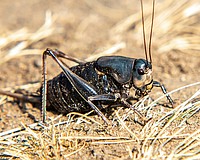
The U.S. Fish & Wildlife Service announced today that the Sand Mountain Blue Butterfly will not be listed as a threatened or endangered species after completing a 12-month review of the unique species.
"Based on the biological evidence we have and looking at the conservation measures being implemented by the Bureau of Land Management, I believe there's enough actions on the ground that the listing is not warranted," said Bob Williams, field supervisor for the Nevada Fish and Wildlife Office.
The initial petition to list the species as threatened or endangered was filed in April 2004 by the Center for Biological Diversity, Xerces Society, Public Employees for Environmental Responsibility and the Nevada Outdoor Recreation Association.
According to information from the Fish & Wildlife Service, the blue butterfly is known to live only at Sand Mountain, a sand dune system about 25 miles east of Fallon. The butterfly depends upon its host plant, the Kearney buckwheat, which grows on about 1,000 acres within the Sand Mountain Recreation Area, managed by the BLM.
Dr. Dennis Murphy from the University of Nevada, Reno conducted a study of the butterfly and its habitat in 2006 from July 15 to Aug. 9. According to the notice published in the Federal Register, which quoted from the study, the scientists made several conclusions.
"First, there was a large number of Sand Mountain blue butterflies - "perhaps hundreds of thousands" - a number "substantially above a level that would indicate a need to carry out ... other actions to enhance population size above a critical minimum."
The notice in the Federal Register further states, "even if this number represents an upper population estimate, we believe that the very large number of butterflies observed during the recent survey clearly shows that the remaining Kearney buckwheat habitat is currently sufficient to support a viable population of the Sand Mountain blue butterfly."
Although the current butterfly population is sizable, the scientists warned that further loss of the buckwheat "will ultimately lead to the elimination of the butterfly."
Under direction of the Lahontan Valley Environmental Alliance, the Sand Mountain Blue Butterfly Working Group was formed in August 2004 with the purpose of providing long term protection for the butterfly and its host plant. The working group involved various parties including BLM, city of Fallon, Churchill County, California Off-Road Vehicle Association, Fallon Paiute Shoshone Tribe, Friends of Sand Mountain, the Sierra Club, Naval Air Station Fallon and the US Fish & Wildlife Service.
The working group produced a conservation plan and agreement which was approved by its signators in September 2006. The conservation plan outlined approved routes for off-highway vehicles which would prevent further degradation of the butterfly's habitat.
The BLM initiated mandatory route restrictions in March 2007 in order to protect the Kearney buckwheat. Don Hicks, Carson City BLM field office manager, said the BLM's primary focus this year will be to fence and sign the route.
"We have to implement the conservation strategy to make sure the species will continue," Hicks said. "The (working group) process was arduous at times, but people kept sight of the goal - how to make it work to permit off-road use and still preserve the butterfly."
Richard Hilton, president of the Friends of Sand Mountain, said some discussion on the final route map still needs to be held and that his group will be present when the BLM installs fencing and markers along the route.
"We worked with the proper authorities to come up with a workable solution," Hilton said. "Most people don't just go out willy nilly on the brush. Most people still staying on the trails."
Fallon Mayor Ken Tedford called the decision a positive for the community and felt all parties in the working group tried to do their part.
"We have a successful plan in place that BLM and Fish & Wildlife Service have worked hard with local and recreational groups and the (Fallon Paiute Shoshone) tribe," said County Manager Brad Goetsch, who also served as co-chair of the working group. "Its been judged to be a high quality and practical plan."
Goetsch felt the city could have felt a significant financial impact if the Fish & Wildlife Service had determined to list the species.
"It really is a substantial draw for tourism," he said.
Rick Gray, executive director of Fallon Convention and Tourism Authority, said a study conducted four years ago revealed a "rough estimate" of $7 million annual revenue to the city and county from Sand Mountain visitors.
|